
Compliance and restrictions
Saudi obligations as modelled objects, not custom fields.
- 12Compliance
- 08Configuration
- 15Alerts
- What
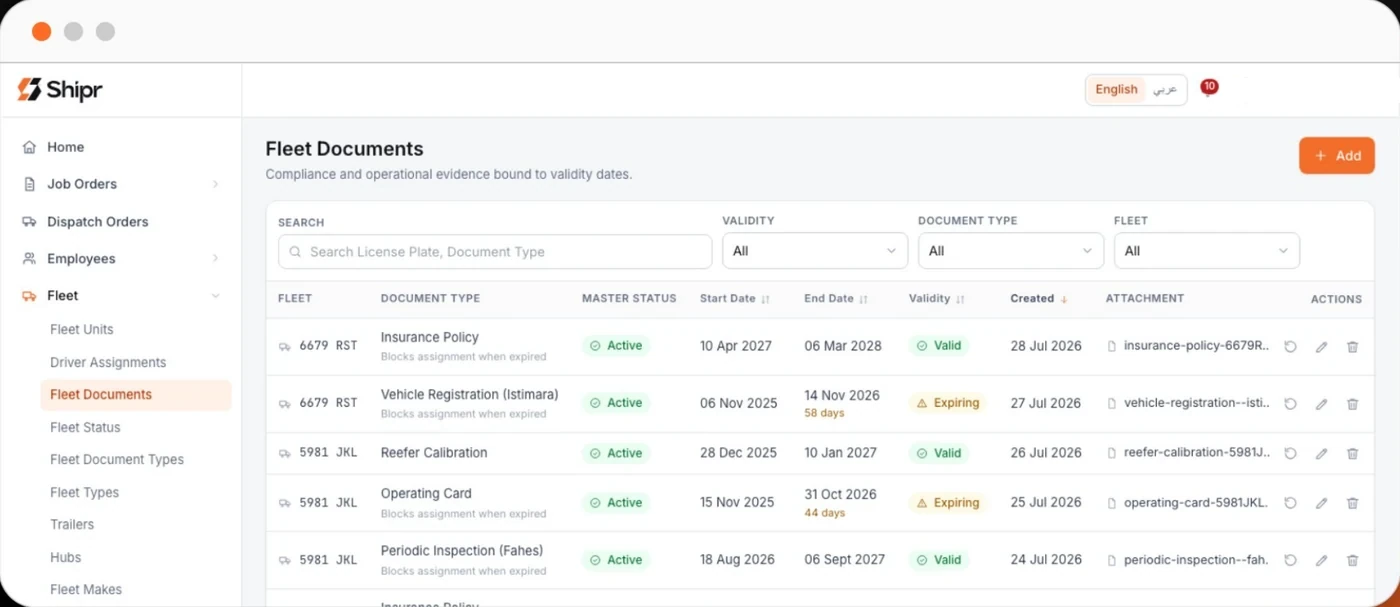
- Saudi obligations are modelled objects, not custom fields. Every workspace opens with 31 seeded requirements; one marked blocking stops dispatch until it is met.
- Who it is for
- Compliance officers, fleet managers and dispatch.
- Problem
- A truck is dispatched on an expired istimara and stopped at a checkpoint.
- How
- Heavy vehicle windows are a regulatory object with authority, window and applicability, so a hold can be explained and, where the contract allows, charged. Starter windows ship inactive: a rule imposes no hold and appears in no statement until a compliance officer activates it with a source reference.
- Value
- Nothing is enforced against an operator until a human has verified its source.
What this settles
- “Can this load move through this city now?”
- Movement restrictions are modelled per city with their windows, and a hold they cause is linked to the delay it produced.
- “What is stopping this dispatch?”
- The blocking requirement is named. Thirty-one are seeded, and which ones block depends on the cargo and the route.
- “Are we compliant, or do we think we are?”
- Requirements carry validity dates and a status derived from them, rather than a folder of scans somebody last checked in March.
What it looks like
In transport management terms
Regulatory compliance and movement restrictions
Saudi obligations modelled as objects a dispatch can be refused against, rather than as custom fields nobody reads. Requirements, validity dates and city movement windows are enforced at assignment, not audited afterwards.
Where it sits in the run
- 01Shipment
- 02Connectivity
- 03Data
- 04Visibility
- 05Intelligence
- 06Decision
- 07Outcome
Where you work in it
- 12Compliance
- 08Configuration
- 15Alerts
The tenant console is a persistent left navigation over a content area, built for operators who live in it all day. A second console serves the platform operator, and a driver application serves the cab.
True of every area
Arabic and English, both first class
Every screen, every document and every export, with full right-to-left layout rather than a translated skin.
Every write is audited
Actor, entity, action and change, appended and never edited. Operator impersonation is visible to the tenant.
Permissions follow the role
Money is a permission rather than a column, and an approval chain belongs to the role that owns it.
It comes out again
Excel, CSV and print to PDF across the reports, with the documents and the audit trail included.
It does not work alone
- Customers and invoicingWho is billed, on what terms, against which contract.Read this area
- Job orders and dispatchThe commercial state of a movement, made executable.Read this area
- Driver evidence and proofEvidence captured where the work happens, travelling with the order.Read this area
- Delay attribution and chargesEvery hour of a late delivery has an owner.Read this area
- Fleet, people and documentsOperational stage is derived, never typed.Read this area
- Maintenance and expensesA release gate that keeps a failed vehicle off the board.Read this area
- Reports, alerts and audit26 parameterised reports, system-raised alerts, an append only audit trail.Read this area
What this changes, by sector
Oil and gas
Hazmat and Civil Defence requirements are modelled objects, and a blocking one stops dispatch.
Construction
Heavy vehicle movement windows carry their authority, their hours and their applicability, so a hold can be explained.
Last mile
Entry restrictions are recorded where dispatch can see them, rather than living in a driver's memory.