
Software for the work that actually happens
IoT Cube builds and runs the platform and connects the fleet. Shipr.me is the product an operator actually works in. Telemetry from one reports against the records of the other, which is why the roadmap builds on this base rather than on a new one.
We think an operation should be able to answer where a load is, why it is late, who owes for the delay and what to invoice for it — from one record, on one screen, in the language the person asking speaks.
That is the whole company. Everything below is a consequence of it.
Software for the work that actually happens
Road freight in the Kingdom runs on people who are very good at their jobs and software that was never written for them. The dispatcher who knows which driver can take a Jeddah run tomorrow keeps it in their head. The proof a load arrived is a photograph in a chat group. The invoice is raised weeks later by somebody reading back through all of it.
We think an operation should be able to answer where a load is, why it is late, who owes for the delay and what to invoice for it — from one record, on one screen, in the language the person asking speaks.
What we hold to
Four commitments that decide arguments internally, and that you are entitled to hold us to.
- 01
Say the true thing
Including when it loses the deal. This site names what the product does not do, who it is not for, and which capability depends on somebody else. An operator finds all of that out eventually; the only question is whether they find it out from us.
- 02
Earn the record
Anything the platform asserts has to be traceable to something that happened — a timestamp, a signature, a span, a document. A number nobody can trace is a number nobody should act on.
- 03
Arabic is not a translation
The Kingdom's operators work in Arabic. A product that treats it as a language pack over an English original fails at the first printed waybill, and tells the people using it exactly where they came in the priority order.
- 04
Ship, then stay
Software for an operation that runs seven days a week is not delivered and left. We are answerable for it on the Thursday afternoon it matters, not only on the day it was signed.
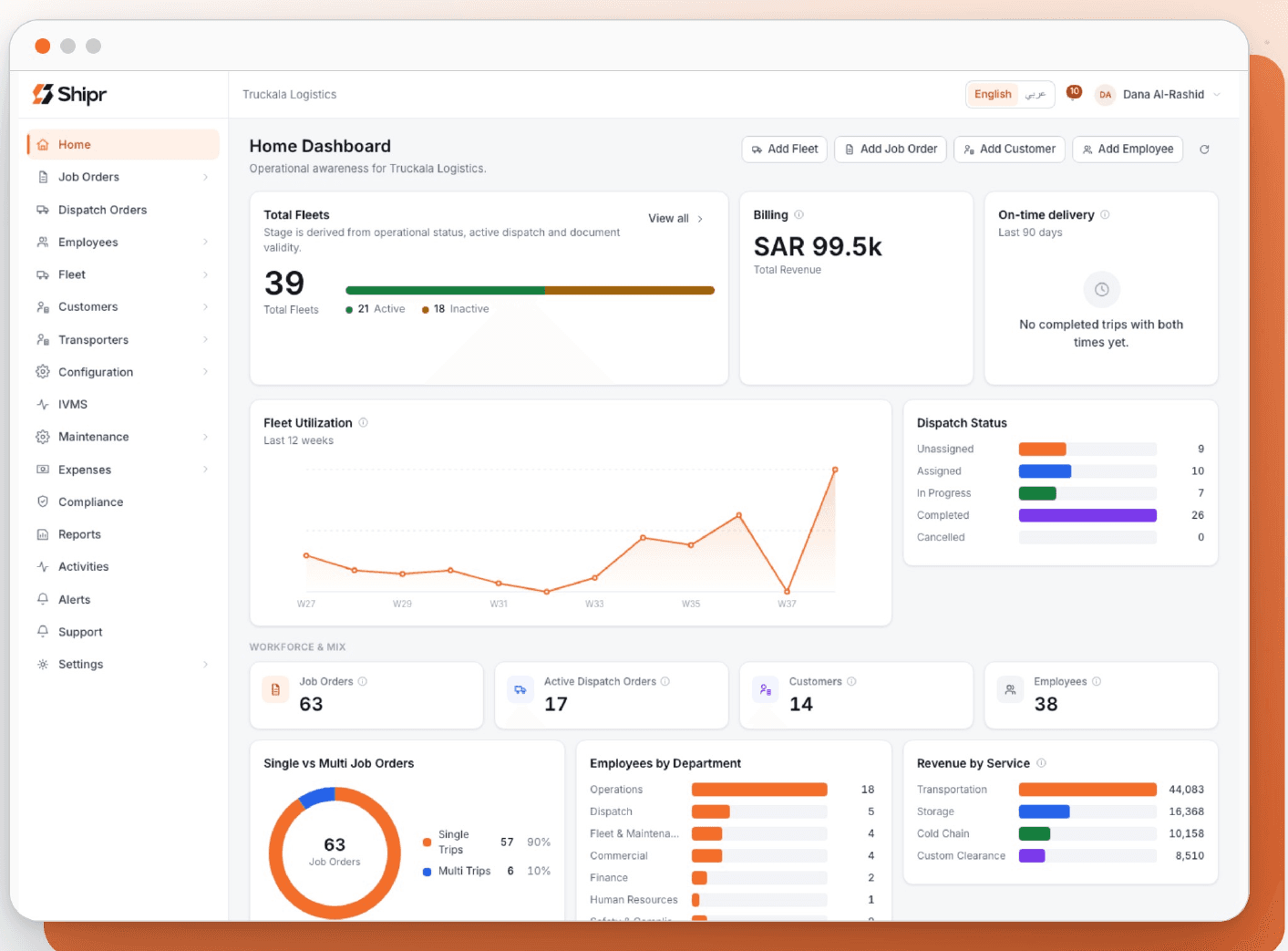
This is the console, not a mockup
Sixteen working areas behind one persistent navigation, built for people who live in it from Sunday morning to Thursday night. The capture below is the home dashboard of the running product against its seeded demonstration workspace.
What is true today
- In production
- Saudi road freight
- Working areas in the console
- 16
- Seeded compliance requirements
- 31
- Parameterised reports
- 26
- Languages, both first class
- English and Arabic
- Working week
- Sunday to Thursday
The standard we hold the work to
Not a promise about the future. A description of how the thing already behaves, which you can check in a demonstration.
It refuses, and says why
A system that lets an unfit vehicle be dispatched and reports it afterwards has helped nobody.
It derives rather than asks
Operational stage, delay attribution and charges are computed from what happened. The few things that must be typed are typed once.
It writes everything down
Actor, entity, action and change. Appended and never edited, and visible to the operator rather than only to us.
It lets go
Records, documents and the audit trail export in formats that open somewhere else. Leaving should be a decision, not a project.
How we work with an operator
Software for an operation that runs seven days a week cannot be delivered and walked away from. This is the shape of it.
We watch the work first
01Before anything is configured, we sit with the dispatchers. A whiteboard tells you more about an operation than a requirements document does.
The workspace is yours alone
02An isolated tenancy at its own address, with your own reference data. Not a shared database with a column for which customer a row belongs to.
Changes ship continuously
03The product moves while you use it. Every operator is on the same version, so nobody is left on an old one to keep a customisation alive.
Your data leaves with you
04Exports of the records, the documents and the audit trail, in formats that open somewhere else. Leaving should be a decision, not a project.
Why the Kingdom, and why road freight
Narrow on purpose. A product that tries to be a global multi-modal platform on day one is a product that is shallow everywhere.
The regulation is specific
ZATCA invoicing, istimara validity, city movement windows and Civil Defence obligations are not parameters on a generic system. Modelling them is most of the work.
The language is not an add-on
Arabic first class and right-to-left throughout, including the documents that print. A translated skin fails at the first waybill.
Road freight is the whole market
Almost everything that moves in the Kingdom moves by road. Adding air and sea would dilute the part that matters here.
We are here
Built in Riyadh, working the Kingdom's week, supporting operators in their own time zone and their own language.
What we do not claim
- No certifications. Only the controls verified in the product requirements are described anywhere on this site.
- No customer logos beyond the operator actually running it, and no testimonials we have not been given.
- Telematics depends on your own account with the IoT platform. Without one the module is reachable and empty, and we say so rather than implying otherwise.
- Anything not yet built is absent from this site rather than described in the present tense.
What we are working on
Stated as work in progress rather than as a promise with a date on it. Anything not on this list is not being built.
Live ZATCA clearance
Invoices are already in ZATCA format with a QR code. Clearing them against the authority in real time needs a production identity.
A published API
With machine identities, which is the prerequisite for anybody building against the platform rather than inside it.
Reaching drivers off the app
An SMS or messaging channel for the drivers who are not on the application. Email and in-app notices exist today.
A second ERP connector
Odoo is connected. The next one follows demonstrated demand rather than a guess about which suite operators run.
Shipr.me is the logistics experience. IoT Cube is the technology foundation powering it.
The logistics experience
The console, the driver app and the operator console. Customers, job orders, dispatch, evidence, compliance, maintenance, expenses and invoicing, in English and Arabic.
Vehicle telemetry reports against the same vehicle, job order and shipment records
The technology foundation
IoT Cube proposes and delivers the transportation management platform, and connects the fleet through its IoT platform, Tracking.me powered by IoT Cube. Device binding, live unit view, violations and driver scorecards flow into Shipr.me from there.
Telematics in Shipr.me depends on a connected IoT platform account. With no provider connected, the module is reachable and empty.