
Customers and invoicing
Who is billed, on what terms, against which contract.
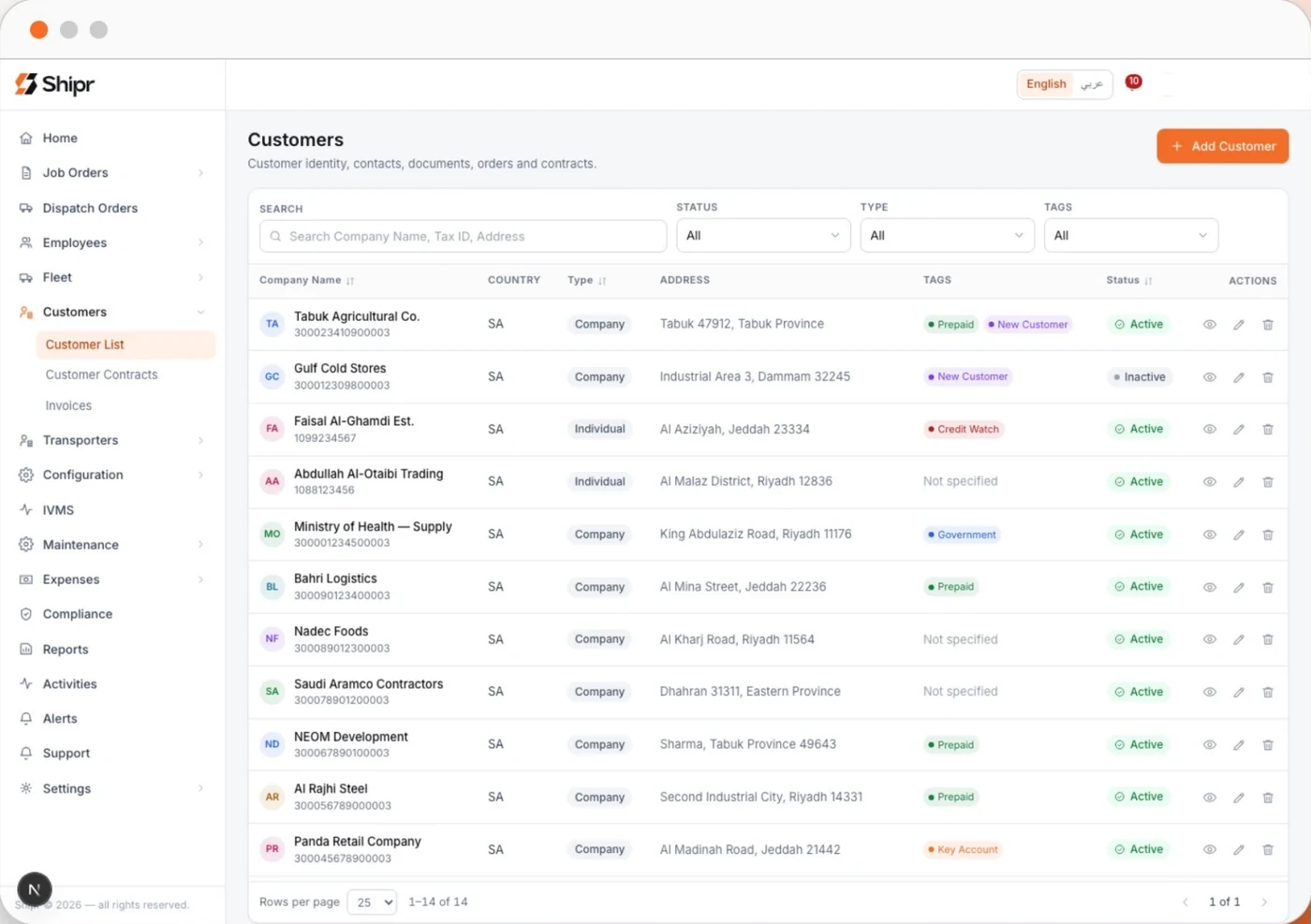
- 06Customers
- 07Transporters
- 13Reports
- What
- The commercial counterparty record: who is billed, on what terms, against which contract. Completed work queues for invoicing.
- Who it is for
- Finance officers, customer service, sales and administrators.
- Problem
- Billing lags execution, and rates get rewritten after the work is done.
- How
- Contracts carry rate cards for transportation, clearance and storage. The rate is snapshotted onto each order. Invoices, credit notes, payments and receivables ageing follow.
- Value
- A bilingual tax invoice in ZATCA format with a QR code, raised from evidence, in the period the work was done.
What this settles
- “Which rate applies to this movement?”
- The one on the contract when the order was raised, snapshotted onto it. A rate card changed last week cannot rewrite what was agreed last month.
- “Why has this work not been invoiced?”
- Completed movements queue for invoicing rather than waiting to be noticed. The queue is the answer, and it is on screen.
- “Is this invoice acceptable to ZATCA?”
- It is raised in ZATCA format, bilingual, with a QR code, in the period the work was done.
What it looks like
In transport management terms
Order-to-cash and freight settlement
What a transport management system calls contract and rate management, freight billing and receivables. Rate cards live on the contract, the rate is snapshotted onto the order, and the invoice is raised from what was executed rather than re-keyed from it.
Where it sits in the run
- 01Shipment
- 02Connectivity
- 03Data
- 04Visibility
- 05Intelligence
- 06Decision
- 07Outcome
Where you work in it
- 06Customers
- 07Transporters
- 13Reports
The tenant console is a persistent left navigation over a content area, built for operators who live in it all day. A second console serves the platform operator, and a driver application serves the cab.
True of every area
Arabic and English, both first class
Every screen, every document and every export, with full right-to-left layout rather than a translated skin.
Every write is audited
Actor, entity, action and change, appended and never edited. Operator impersonation is visible to the tenant.
Permissions follow the role
Money is a permission rather than a column, and an approval chain belongs to the role that owns it.
It comes out again
Excel, CSV and print to PDF across the reports, with the documents and the audit trail included.
It does not work alone
- Job orders and dispatchThe commercial state of a movement, made executable.Read this area
- Driver evidence and proofEvidence captured where the work happens, travelling with the order.Read this area
- Delay attribution and chargesEvery hour of a late delivery has an owner.Read this area
- Fleet, people and documentsOperational stage is derived, never typed.Read this area
- Maintenance and expensesA release gate that keeps a failed vehicle off the board.Read this area
- Compliance and restrictionsSaudi obligations as modelled objects, not custom fields.Read this area
- Reports, alerts and audit26 parameterised reports, system-raised alerts, an append only audit trail.Read this area
What this changes, by sector
Distribution
A standing contract carries the rate card, and the rate is snapshotted onto every order — so the weekly run is priced once, not renegotiated after each delivery.
Oil and gas
Rates that survive an audit, and an invoice raised in the period the work was done rather than the month somebody found the paperwork.
Trucking and logistics
A mixed customer base, each on its own terms, with completed work queuing itself for invoicing.