
What is a transport management system
A TMS is the system of record for moving goods: it plans the work, runs it, and tells you afterwards what it cost and who caused what. This page explains the category in plain terms, and then says which parts of it Shipr.me covers and which it does not.
- 01PlanTurning demand into work: taking the booking, pricing it against the right contract, and deciding which vehicle and driver should carry it in which window.
- 02ExecuteRunning the work and capturing what happened: dispatching to the driver, collecting evidence on the road, tracking the movement, and handling the exceptions when the plan and the day disagree.
- 03OptimiseLearning from what happened: measuring cost and performance, attributing delay, and settling the money with evidence behind it.
The short answer
A transport management system is the software an operation uses to plan, execute and settle the physical movement of goods. It holds the order, the vehicle and driver assigned to it, what happened on the road, the documents that prove it, and the money that follows. Anything you would otherwise keep on a whiteboard, in a spreadsheet, in a chat group and in an accounting package belongs in one of those four places instead.
It is not a tracking product and it is not an accounting package. Tracking answers where a vehicle is. Accounting answers what was billed. A TMS is the record in between that makes the second follow from the first.
What sits beside it
- Telematics and IoT
- Position, speed and driver behaviour come from devices on the vehicle. A TMS consumes that feed; it does not manufacture it.
- Accounting and ERP
- The ledger, the tax filing and the general accounts stay where they are. A TMS hands them invoices raised from work that actually happened.
- Warehouse systems
- What is in the building is a different question from what is on the road. The handover between them is the order.
Plan, execute, optimise
The category is usually described in three phases, and it is a good description. What differs between systems is how much of each they actually do, so each phase here says what the phase means and then what Shipr.me does inside it.
- 01
Plan
Turning demand into work: taking the booking, pricing it against the right contract, and deciding which vehicle and driver should carry it in which window.
A booking becomes a job order with the customer, the contract rate, the route, the cargo and the delivery date on it. Dispatch turns that into a specific vehicle, a specific driver and a planned window — and refuses the assignment when the vehicle, the driver or a document is not fit to carry it.
- 02
Execute
Running the work and capturing what happened: dispatching to the driver, collecting evidence on the road, tracking the movement, and handling the exceptions when the plan and the day disagree.
The driver application records duty, the walk around, acceptance, trip events, cargo condition and proof of delivery. Position arrives from the connected IoT platform. All of it writes to the order it belongs to, so nothing has to be reconciled later.
- 03
Optimise
Learning from what happened: measuring cost and performance, attributing delay, and settling the money with evidence behind it.
Waiting time is measured as spans and each span is attributed to the party that caused it, so the charge is derived rather than argued. Cost per kilometre comes off maintenance and expenses. Twenty-six reports and a system-raised alert set sit over the same records.
Signs an operation has outgrown what it has
None of these is about software. They are the symptoms operators describe before they know there is a category of product that fixes them.
- Answering “where is my load” takes a phone call to a driver
- The same weekly run is keyed from scratch every week
- Waiting time is argued about rather than measured
- Invoices go out weeks after the work, or not at all
- A truck was stopped for a document somebody meant to renew
- Nobody can say what a vehicle costs per kilometre
- Two people have different numbers for the same month
Against what most operations run today
The honest comparison is not with another TMS. It is with the four things already in place, each of which does its own job well and none of which was built for this one.
A spreadsheet
Flexible, free, and understood by everyone. It has no idea a document expired, cannot refuse an assignment, and holds one version of the truth per person who has a copy.
A tracking portal
Answers where a vehicle is, accurately and in real time. It does not know what the vehicle was carrying, who it was for, or what the movement is worth.
An accounting package
Correct about money and weeks behind the road. It learns about a trip when somebody types it in, which is why detention is almost never billed.
A chat group
Where the operation actually coordinates. Nothing in it is a record: it cannot be searched as evidence, reported on, or shown to a customer in a dispute.
Who runs one
Any operation whose vehicles, drivers and invoices have stopped fitting in a spreadsheet. In the Kingdom that is usually one of these.
Road freight carriers
A fleet moving other people's goods under contract, where the rate, the proof and the invoice have to agree.
Distributors with their own fleet
Delivery is part of the product, and the cost of running it has to be visible next to the margin on what is being delivered.
Logistics service providers
Multiple customers on different terms, each expecting their own view of their own work.
Project and industrial movers
Fewer movements, higher value, and permits and restrictions that decide whether a load goes at all.
What an operation gets from one
Written for road freight in the Kingdom rather than for global multi-modal logistics, because that is the work this is for.
One answer to “where is it”
The order, the assignment, the events and the proof are the same record, so the answer is on a screen rather than at the end of three phone calls.
Revenue that stops leaking
Waiting and detention are the charges most operations never bill, because nobody wrote the time down. Measured automatically, they become invoiceable.
Invoices raised in the period
Billing follows execution instead of trailing it by weeks, and the rate on the invoice is the rate that was agreed before the work started.
Disputes settled from evidence
A signature, a photograph and a timestamp against the order beat two people’s recollections of a delivery six weeks ago.
Compliance enforced, not audited
An expired document stops a dispatch at the point of assignment rather than at a checkpoint.
A cost per kilometre you can trust
Fuel, servicing, defects and workshop time against the vehicle that incurred them, so a rate can be quoted against a real number.
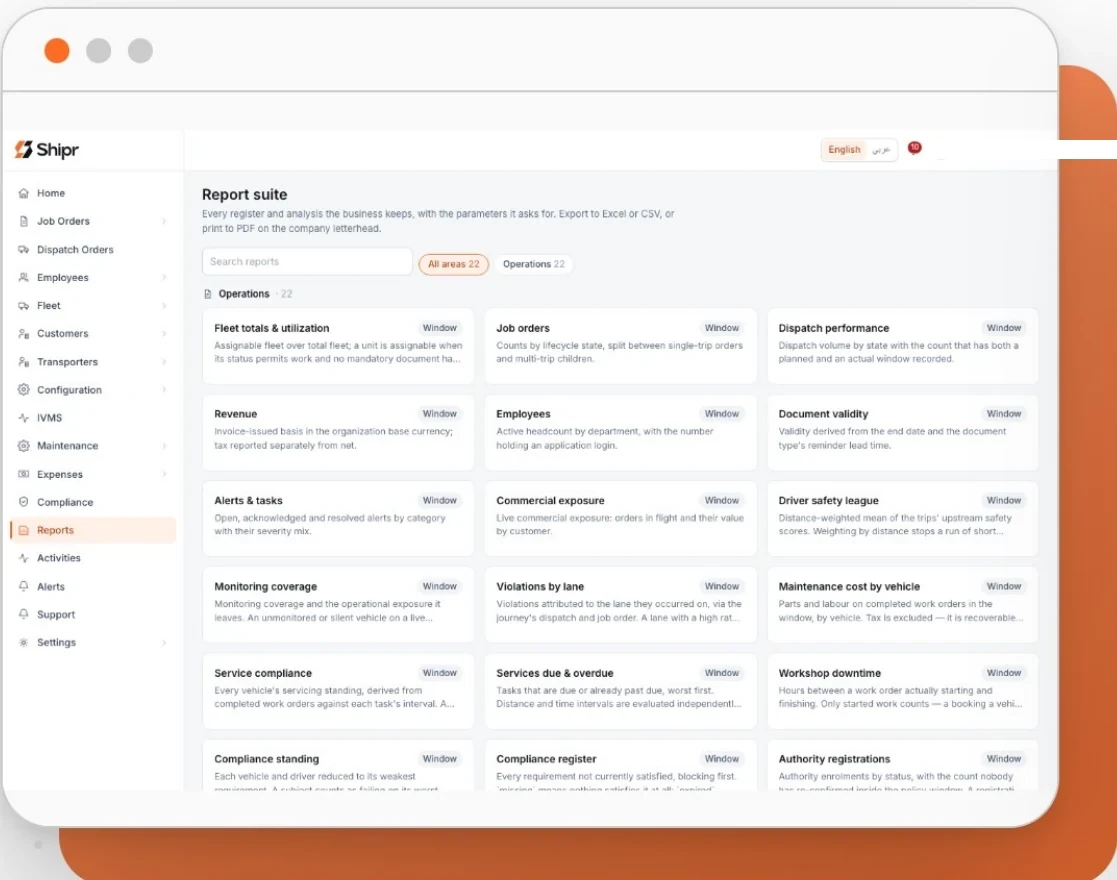
What Shipr.me does, and what it does not
The category description above is broader than this product. Naming the difference is more useful than implying the whole list, so here it is.
In the product today
- Job orders, dispatch orders and a four-view dispatch board
- Contract rate cards, rate snapshotting and ZATCA bilingual invoicing
- Driver application with proof of delivery and cargo condition
- Delay spans attributed to customer, carrier, regulator or nobody
- Fleet, driver and document registers that gate assignment
- Maintenance, expenses and cost per kilometre
- Saudi compliance requirements and city movement restrictions
- Twenty-six reports, system-raised alerts and an append only audit trail
Not in the product
- Air and sea freight. This is a road freight system.
- Carrier rate shopping across a market of carriers.
- Automatic route optimisation or load-building algorithms.
- Customs brokerage and international trade documentation.
- Warehouse management. Storage is priced, not operated.
- Machine-learned transit predictions.
Telematics is a connected account on the IoT platform rather than something Shipr.me manufactures. With no provider connected, the module is reachable and empty.
How to evaluate one
Questions worth asking any vendor in this category, including us. If a demonstration cannot answer them on the running product, it has not answered them.
- “Show me an assignment being refused”
- Every system can dispatch. The ones worth having can decline to, for a reason they will state on screen.
- “Where does this number come from?”
- Point at any figure in a report and ask what it is derived from. A number somebody typed is a number somebody can type differently.
- “Raise an invoice from a movement, now”
- Not a sample invoice. A movement you have just watched, priced from the rate agreed before it started.
- “Who owns these two hours?”
- Ask it about a delay. If the answer is a text field somebody fills in, attribution is a report rather than a mechanism.
- “Show me the same screen in Arabic”
- Including a document that prints. A translated interface over a left-to-right product fails at the first waybill.
- “What happens if we leave?”
- Ask what comes out, in what format, and how long it takes. The answer tells you how the relationship is expected to work.
The words you will hear
The category has its own vocabulary, most of it borrowed from global logistics. What each term means here.
- Job order
- The commercial state of a movement: who it is for, at what rate, on what route, by when.
- Dispatch order
- That job order made executable — a specific vehicle, a specific driver, a planned window.
- ePOD
- Electronic proof of delivery. A signature, an OTP or a photograph captured at the point of delivery.
- Detention and demurrage
- Charges for time a vehicle or container is held beyond what was agreed.
- Accessorial charges
- Anything billed beyond the line haul rate: waiting, extra stops, handling, restriction holds.
- Freight audit
- Checking that what is invoiced matches what was contracted and what actually happened.
- Line haul
- The core movement from origin to destination, before anything is added to it.
- Rate card
- The agreed prices on a contract, snapshotted onto an order so a later change cannot rewrite history.
- Attribution
- Deciding which party caused a delay, and therefore who carries its cost.
- IVMS
- In-vehicle monitoring system. The telematics device and feed that reports position and driving behaviour.