
Maintenance and expenses
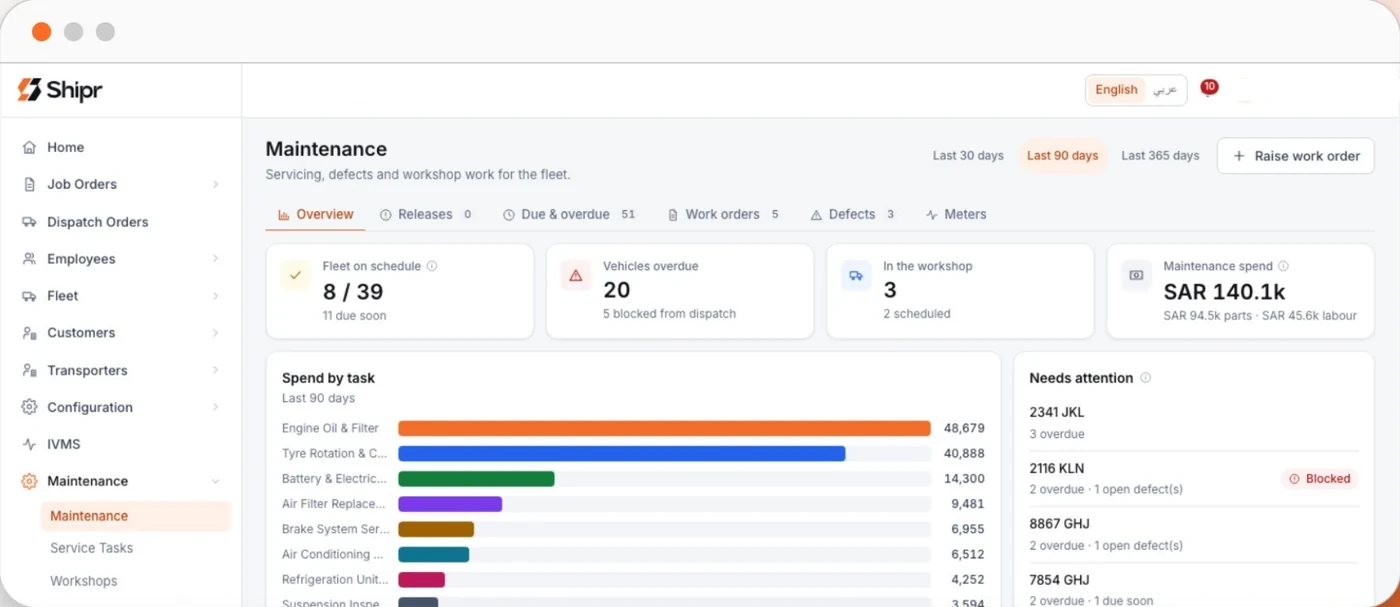
A release gate that keeps a failed vehicle off the board.
- 10Maintenance
- 11Expenses
- 05Fleet
- What
- Work orders, defects, service tasks, a parts catalogue, workshops and meter readings, with a release gate that keeps a failed vehicle off the board.
- Who it is for
- Workshop supervisors, fleet managers and finance.
- Problem
- Unplanned downtime, and no clear view of what the fleet actually costs.
- How
- Expenses are recorded against a category, a vehicle, a driver and optionally a dispatch. Fuel entries carry litres and odometer, from which cost per kilometre is derived. Driver claims from the mobile app enter as pending and need office approval; trip advances have their own lifecycle.
- Value
- Less unplanned downtime and a clearer view of what the fleet actually costs.
What this settles
- “What does this vehicle cost us per kilometre?”
- Fuel, servicing, defects and workshop time recorded against the vehicle that incurred them, divided by the distance it ran.
- “Why is this truck off the board?”
- A defect, a service or a critical walk around failure, with the release gate that keeps it off until it is resolved.
- “Which vehicles are overdue for service?”
- Service intervals and overdue work are on the maintenance register, and they reach the dispatch board rather than a separate spreadsheet.
What it looks like
In transport management terms
Maintenance management and transport cost control
Servicing, defects and workshop time against the fleet, with fuel and running costs beside them. It is what turns a fleet register into a cost per kilometre you can put next to a rate.
Where it sits in the run
- 01Shipment
- 02Connectivity
- 03Data
- 04Visibility
- 05Intelligence
- 06Decision
- 07Outcome
Where you work in it
- 10Maintenance
- 11Expenses
- 05Fleet
The tenant console is a persistent left navigation over a content area, built for operators who live in it all day. A second console serves the platform operator, and a driver application serves the cab.
True of every area
Arabic and English, both first class
Every screen, every document and every export, with full right-to-left layout rather than a translated skin.
Every write is audited
Actor, entity, action and change, appended and never edited. Operator impersonation is visible to the tenant.
Permissions follow the role
Money is a permission rather than a column, and an approval chain belongs to the role that owns it.
It comes out again
Excel, CSV and print to PDF across the reports, with the documents and the audit trail included.
It does not work alone
- Customers and invoicingWho is billed, on what terms, against which contract.Read this area
- Job orders and dispatchThe commercial state of a movement, made executable.Read this area
- Driver evidence and proofEvidence captured where the work happens, travelling with the order.Read this area
- Delay attribution and chargesEvery hour of a late delivery has an owner.Read this area
- Fleet, people and documentsOperational stage is derived, never typed.Read this area
- Compliance and restrictionsSaudi obligations as modelled objects, not custom fields.Read this area
- Reports, alerts and audit26 parameterised reports, system-raised alerts, an append only audit trail.Read this area
What this changes, by sector
Trucking and logistics
Fuel entries carry litres and odometer, so cost per kilometre is derived per unit rather than estimated across the fleet.
Car carrier
A defect on a specialised trailer keeps it off the board until it is released.
Distribution
Fuel economy and running cost across a high-frequency fleet, per vehicle.