
Driver evidence and proof
Evidence captured where the work happens, travelling with the order.
- 03Dispatch orders
- 04Employees
- 14Activities
- What
- Evidence is captured where the work happens and travels with the order to the invoice. Driver notices for assignments, windows, readiness and waybill events are retried until delivered.
- Who it is for
- Drivers in the cab, with dispatch and operations reading what they capture.
- Problem
- Proof of delivery arrives as a photograph in a chat group, or not at all.
- How
- A six step flow: duty session, walk around, assignment, trip events, cargo and damage, proof of delivery.
- Value
- A missing proof is flagged, never invented.
What this settles
- “Did this delivery actually happen?”
- A signature, an OTP or paper, captured at the point of delivery and attached to the order. A missing proof is flagged rather than invented.
- “Who signed for it, and when?”
- The proof carries its own timestamp and source, and it travels with the order to the invoice raised from it.
- “Was the cargo damaged before or after we took it?”
- Condition is recorded against the cargo line at the walk around and at delivery, with cause and liability.
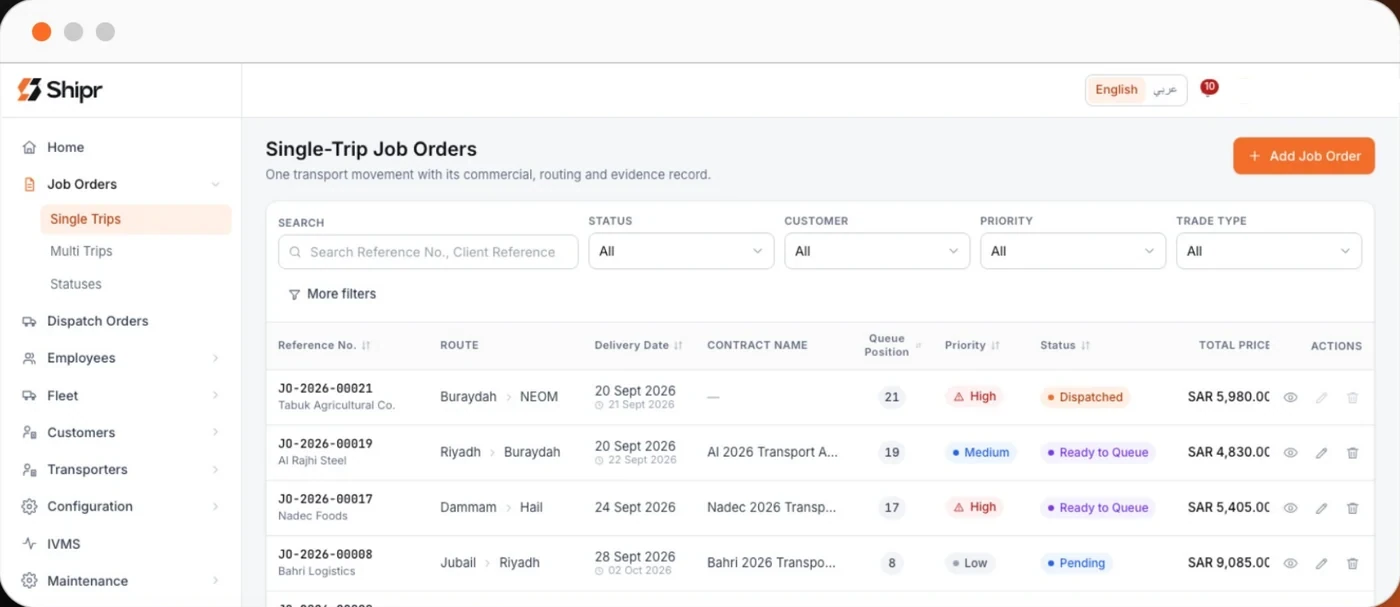
What it looks like
In transport management terms
Electronic proof of delivery
ePOD, captured in the cab rather than typed in afterwards. Duty, walk around, assignment, trip events, cargo condition and signature all attach to the order they belong to and travel with it to the invoice.
Where it sits in the run
- 01Shipment
- 02Connectivity
- 03Data
- 04Visibility
- 05Intelligence
- 06Decision
- 07Outcome
Where you work in it
- 03Dispatch orders
- 04Employees
- 14Activities
The tenant console is a persistent left navigation over a content area, built for operators who live in it all day. A second console serves the platform operator, and a driver application serves the cab.
How it runs
Duty session
01On duty and off duty recorded separately from attendance.
Walk around
02Checklist with severity. A critical failure blocks the vehicle until a release is granted.
Assignment
03Accept or decline with a reason. A decline returns the dispatch to unassigned.
Trip events
04Stated times are bounded and their capture source is recorded.
Cargo and damage
05Damage recorded against cargo lines with cause and liability.
Proof of delivery
06Signature, OTP or paper. A missing proof is flagged, never invented.
The driver mobile application is a separate codebase. This flow is documented from the platform API the app calls and the data it writes.
True of every area
Arabic and English, both first class
Every screen, every document and every export, with full right-to-left layout rather than a translated skin.
Every write is audited
Actor, entity, action and change, appended and never edited. Operator impersonation is visible to the tenant.
Permissions follow the role
Money is a permission rather than a column, and an approval chain belongs to the role that owns it.
It comes out again
Excel, CSV and print to PDF across the reports, with the documents and the audit trail included.
It does not work alone
- Customers and invoicingWho is billed, on what terms, against which contract.Read this area
- Job orders and dispatchThe commercial state of a movement, made executable.Read this area
- Delay attribution and chargesEvery hour of a late delivery has an owner.Read this area
- Fleet, people and documentsOperational stage is derived, never typed.Read this area
- Maintenance and expensesA release gate that keeps a failed vehicle off the board.Read this area
- Compliance and restrictionsSaudi obligations as modelled objects, not custom fields.Read this area
- Reports, alerts and audit26 parameterised reports, system-raised alerts, an append only audit trail.Read this area
What this changes, by sector
Last mile
Signature or OTP at the door, captured in the cab and attached to the record that becomes the invoice.
Car carrier
Damage recorded against the individual vehicle line, with cause and liability, not as a note on the whole load.
Oil and gas
A critical walk-around failure blocks the vehicle until a release is granted — before a hazmat load moves, not after.