
Delay attribution and charges
Every hour of a late delivery has an owner.
- 03Dispatch orders
- 13Reports
- 15Alerts
- What
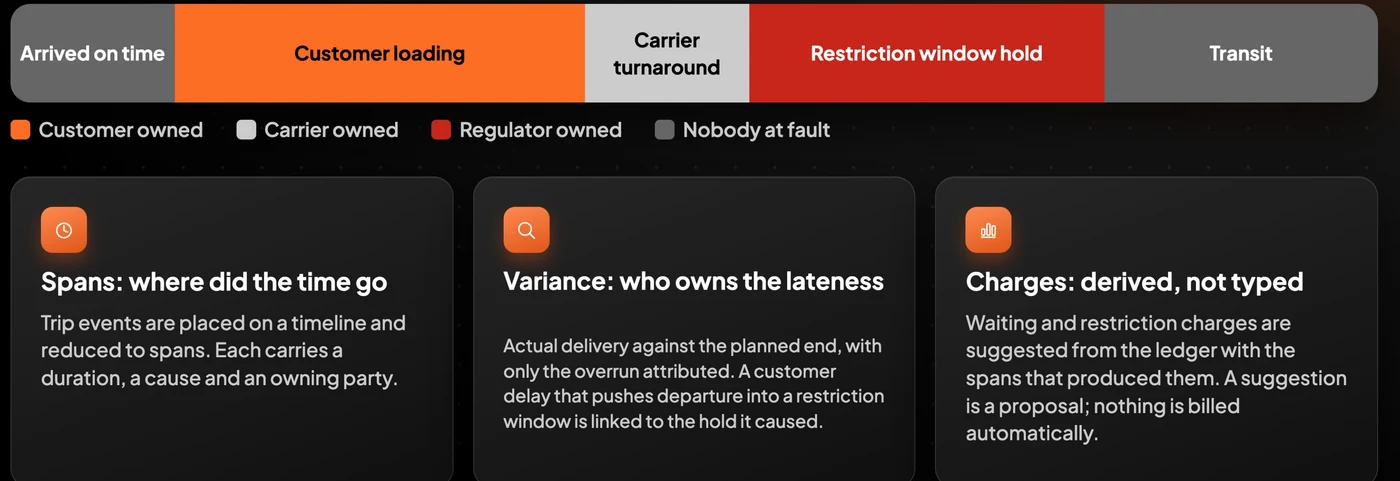
- Trip events are placed on a timeline and reduced to spans. Each span carries a duration, a cause and an owning party: customer, carrier, regulator, or nobody at fault.
- Who it is for
- Operations managers, finance officers and anyone defending an invoice.
- Problem
- The customer is charged for waiting they caused, or the carrier absorbs it. Both end in dispute.
- How
- Actual delivery is measured against the planned end, with only the overrun attributed. A customer delay that pushes departure into a restriction window is linked to the hold it caused. Waiting and restriction charges are suggested from the ledger with the spans that produced them.
- Value
- A suggestion is a proposal. Nothing is billed automatically.
What this settles
- “Whose two hours were those?”
- The span is attributed to customer, carrier, regulator or nobody at fault, from the trip events rather than from somebody's account of them.
- “Can we bill for this waiting time?”
- A charge is suggested from the ledger with the span that produced it. A suggestion is a proposal; nothing is billed automatically.
- “The customer disputes the lateness. What do we show them?”
- The timeline, the spans on it, and which party owns each one — against the planned end rather than against an opinion.
What it looks like
In transport management terms
Detention, demurrage and accessorial charges
The part of freight audit most systems leave to argument. Waiting time is measured as spans, each span is attributed to the party that caused it, and the charge is derived from the span rather than typed by whoever is billing.
Where it sits in the run
- 01Shipment
- 02Connectivity
- 03Data
- 04Visibility
- 05Intelligence
- 06Decision
- 07Outcome
Where you work in it
- 03Dispatch orders
- 13Reports
- 15Alerts
The tenant console is a persistent left navigation over a content area, built for operators who live in it all day. A second console serves the platform operator, and a driver application serves the cab.
True of every area
Arabic and English, both first class
Every screen, every document and every export, with full right-to-left layout rather than a translated skin.
Every write is audited
Actor, entity, action and change, appended and never edited. Operator impersonation is visible to the tenant.
Permissions follow the role
Money is a permission rather than a column, and an approval chain belongs to the role that owns it.
It comes out again
Excel, CSV and print to PDF across the reports, with the documents and the audit trail included.
It does not work alone
- Customers and invoicingWho is billed, on what terms, against which contract.Read this area
- Job orders and dispatchThe commercial state of a movement, made executable.Read this area
- Driver evidence and proofEvidence captured where the work happens, travelling with the order.Read this area
- Fleet, people and documentsOperational stage is derived, never typed.Read this area
- Maintenance and expensesA release gate that keeps a failed vehicle off the board.Read this area
- Compliance and restrictionsSaudi obligations as modelled objects, not custom fields.Read this area
- Reports, alerts and audit26 parameterised reports, system-raised alerts, an append only audit trail.Read this area
What this changes, by sector
Distribution
Waiting at a customer's dock is suggested as a charge from the evidence, instead of being absorbed because nobody wrote the time down.
Construction
A hold at a restriction window is attributed to the authority that imposed it, and linked to the delay that pushed you into it.
Trucking and logistics
A disputed delivery is settled from the ledger rather than from two people's recollections.